MARTIN MAWAYA
GWERU—For years, shoe repair has been a men’s trade, a gritty, low-margin craft dominated by men hunched over wooden boxes and battered toolkits.
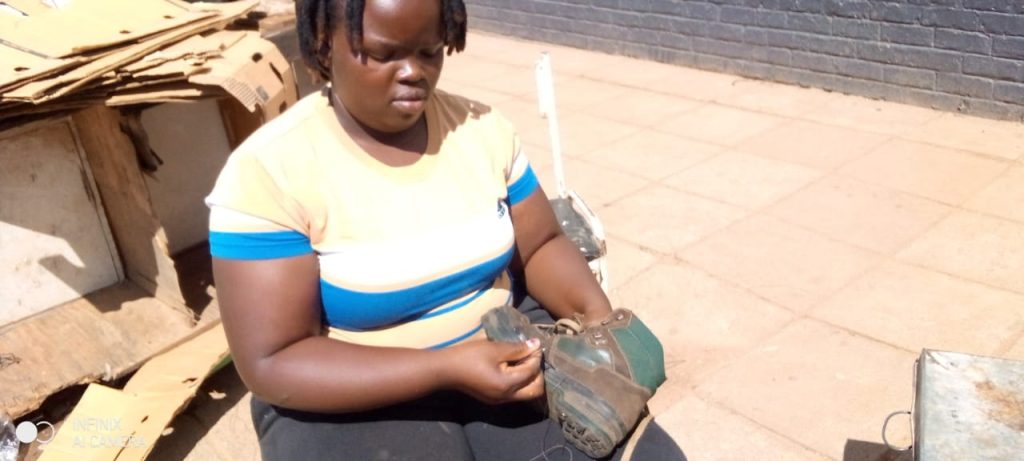
But Fungai Mhosva, a widow and mother of three, has quietly broken that tradition.
Sitting on a cracked pavement in Gweru’s central business district, amid dust and constant traffic, Mhosva bends over a worn-out sneaker, her fingers moving with practiced precision.
The needle pierces tired leather, pulling it back into shape, much like the life she has been stitching together since tragedy struck.
She did not inherit the trade, but what began as desperation in 2017 has become defiance.
Mhosva learnt by watching others, asking questions, and enduring ridicule from men who initially dismissed her presence.
“When my husband died, everything stopped,” she says, not looking up. “There was no income, no savings. The children had to eat, go to school. I had no choice but to do something — anything.”
“At first they laughed,” she recalls. “They said, ‘This is not for women.’ But hunger is stronger than shame.”
Her workstation is modest; a used mealie-meal sack containing glue tins, thread, scraps of rubber and leather, arranged on the roadside.
There is no shelter from the blistering sun or sudden rains. Yet from this exposed corner, she earns just enough to keep her family afloat.
Her persistence has inspired another single mother, Paidamoyo Ndlovu, who operates opposite Colcom and followed her lead at the age of 22, carving out space in the same male-dominated trade.
“I saw her surviving here,” says Ndlovu. “I thought, maybe I can also do it. It’s better than sitting at home with nothing.”
Survival in the shadows
However, the two are surviving in the shadows, operating in a regulatory grey zone.
Working from undesignated spaces, they are in constant conflict with municipal authorities.
Raids are common, tools are sometimes confiscated, and on bad days they are chased away like trespassers in the very city they call home.
“Sometimes they come and scatter everything,” says Ndlovu. “You lose customers, you lose money. But where else can we go?”
Without licences or designated workspaces, they lack protection, not just from authorities, but from harassment and abuse.
“There are men who insult you, who think because you are here you are weak,” Mhosva says. “Others try to take advantage.”
Health risks are a daily reality. They work without protective clothing, handling sharp tools, industrial adhesives and worn materials that may carry infections.
They work in the open, inhaling dust and fumes, with no access to sanitation facilities or clean water.
“When it’s hot, the glue fumes are too much,” Ndlovu says. “You feel dizzy. But you can’t stop working.”
Their vulnerability was recently exposed when Mhosva lost all her tools, along with customers’ shoes, after someone mistakenly took the sack she used to store her equipment.
There was no compensation, forcing her to start again from scratch.
A poor nation, not poor people
Their struggle reflects a broader paradox; a country rich in potential, yet weighed down by structural challenges.
Zimbabwe’s informal sector now sustains millions amid limited formal employment and economic strain.
“These women are not poor because they lack ideas,” community development leader Cornelia Selipiwe has said. “They are poor because the system does not accommodate them.”
Despite years of working on the streets and even attracting regular clients, including businesspeople, meaningful support has remained elusive.
“No one has ever come to say, ‘How can we help you grow?’” Mhosva says.
On paper, frameworks to empower women exist.
Zimbabwe’s Constitution guarantees gender equality, while national policies and international commitments such as the Convention on the Elimination of All Forms of Discrimination Against Women (CEDAW) and the Beijing Platform for Action underscore inclusion.
Yet for women on the margins, these commitments often feel distant.
“We hear about loans and empowerment programmes,” says Mhosva. “But you need collateral, connections. We have neither.”
Critics say many initiatives are captured by elites or those with proximity to power, leaving out grassroots women in the informal economy.
“The gap is not policy, it is implementation,” Zimbabwe Congress of Trade Unions Central region gender desk representative Angela Chipfuwa says.
Analysts say ring-fencing a portion of devolution funds at provincial level, through a deliberate and structured framework for women-led micro-enterprises, particularly those without collateral could transform livelihoods at community level.
“This is where local authorities can act,” added Selipiwe. “Designate safe trading spaces, provide basic infrastructure, and create microfinance schemes tailored to informal women traders.”
Targeted support, including secure workspaces, starter toolkits, access to protective equipment and affordable credit, could help formalize these enterprises and improve both livelihoods and urban order.
For funders, government, local authorities, corporates and development partners, the need is urgent; invest in grassroots women who are already demonstrating resilience and enterprise under difficult conditions.
Holding on to hope
As the afternoon sun dips, Mhosva finishes stitching a sneaker and hands it back to its owner. Another small victory. Another day survived.
Asked about the future, she pauses.
“I just want a better place to work from,” she says. “A small shop, proper tools. Something stable.”
Ndlovu echoes the same: “We don’t want charity. We want opportunites.”
For now, they remain on the margins, visible yet overlooked, essential yet unsupported. But in every sole they mend, in every stitch they pull tight, they assert a quiet truth; resilience can outlast neglect.
Their story is more than survival. It is a call to recognise, to invest, and to create pathways for women who are already building their future.