Tendai Muererwa
Mutare – The Government has taken a decisive step toward protecting its citizens from severe weather events by launching two landmark environmental frameworks in Mutare: the National Action Plan for Early Warnings for All (EW4All) and the National Nature-Based Solutions Strategy for Climate Change Adaptation.
Together, these initiatives mark a major shift in how the nation prepares for, copes with and adapts to climate driven hazards.
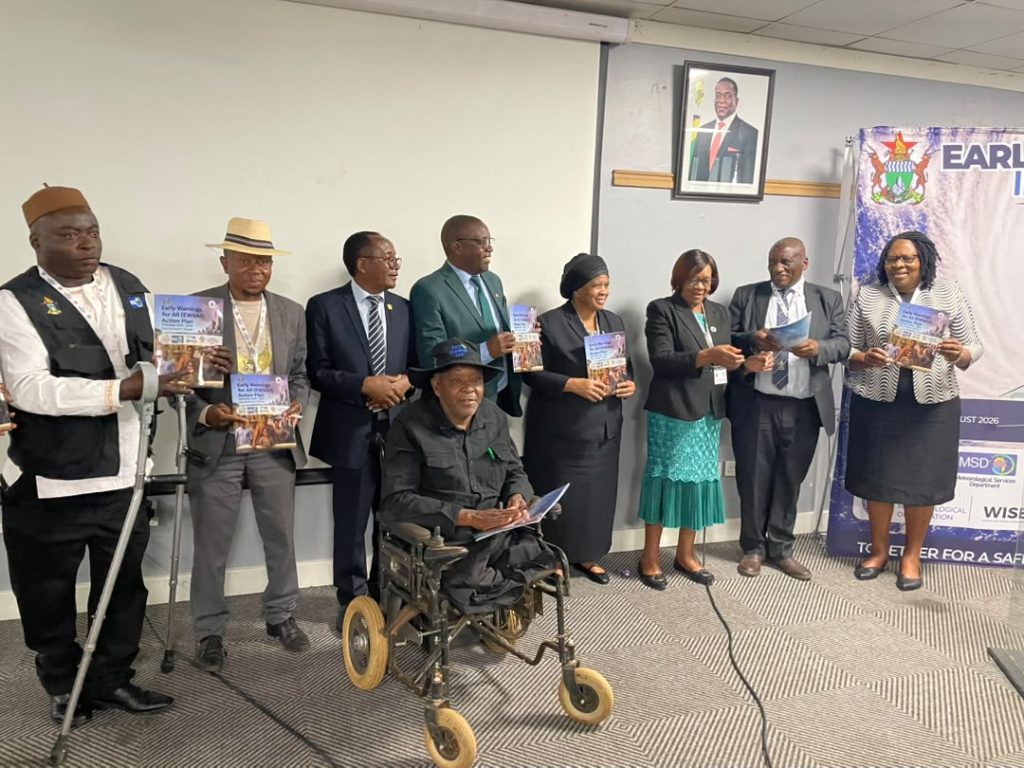
The Early Warnings for All initiative is a global commitment designed to ensure that every person receives timely and actionable safety information before disaster strikes. In Zimbabwe, the Meteorological Services Department led the creation of this operational blueprint throughout 2026, collaborating closely with key institutions such as the Department of Civil Protection the Zimbabwe National Water Authority, POTRAZ and the Zimbabwe Red Cross Society. Officially unveiled on 20 August 2026, the framework bridges scientific data with everyday action, helping communities act well before hazards escalate into full-scale disasters.
Launching the plan in Mutare carried deep symbolic and practical weight, as Manicaland Province suffered severe devastation natural disaster during Cyclone Idai. Environment Climate and Wildlife Minister Evelyn Ndlovu emphasized that the initiative fulfills a vital national responsibility to safeguard every village across the country. By connecting early warnings to community-level response, the government aims to establish a reliable foundation for long-term climate resilience and economic stability under Vision 2030.
To make early warnings accurate and reliable, the government has invested heavily in modernizing weather observation tools nationwide. According to Meteorological Services Department Director Rebecca Manzou, key upgrades include the installation of modern weather radars for national coverage, automated weather stations across all 47 synoptic stations and major airports, flood-level gauges and lightning detection systems. These technical enhancements significantly improve numerical weather prediction models to give advance warning on severe weather.
A core objective of the new framework is moving away from simple forecasts. Instead of merely telling people what the weather will be, forecasters will focus on explaining what the weather will do to everyday lives, crops and infrastructure. Authorities are building digitized hazard maps covering all 60 rural districts in Zimbabwe to highlight flood-prone regions, drought-sensitive areas and landslide hotspots. This data feeds into a centralized National Disaster Risk Information Management System to guide evacuations, agricultural planning and emergency responses.
Despite these technical strides, key challenges remain. Climate related disasters have already cost Zimbabwe over US$950 million, and the Meteorological Services Department continues to face shortages of specialized technical personnel.
To complement the early warning systems, the Ministry, supported by the UNDP and FCDO also validated the draft National Nature Based Solutions Strategy. Expanding from four initial pilot districts to a nationwide rollout, this strategy focuses on using natural resources like forests, wetlands and soils to absorb climate shocks, restore ecosystems, protect biodiversity and create sustainable rural jobs.