MILLICENT HUNGWE
MASVINGO-The Environmental Management Agency (EMA) has released its 2026 national veldfire risk prediction, warning Zimbabweans that the country is still facing a serious fire threat.
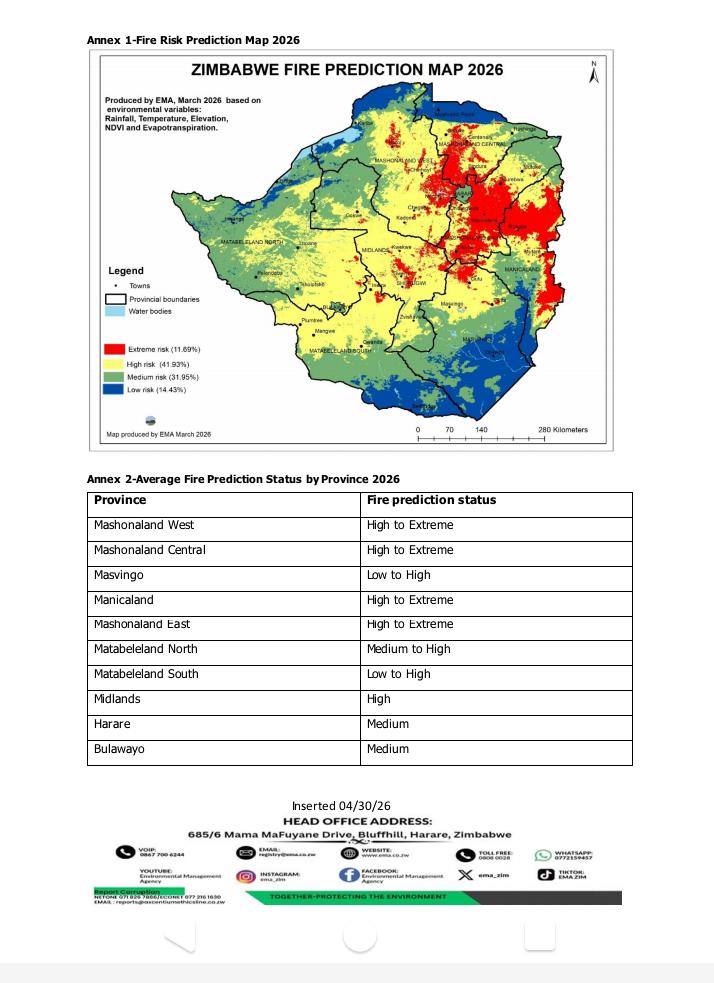
According to the report, in the south-eastern region, Masvingo Province has been classified from low risk in 2025 to high risk this year, placing it in a mixed-risk category compared to other parts of the country.
EMA spokesperson, Amkela Sidange told The Midweek Watch that while Masvingo province is not among the most extreme zones, she emphasized that it remains highly vulnerable due to dry grass, changing weather conditions, and human activities such as land clearing and fire misuse.
“This means that some districts in Masvingo may experience relatively lower risk, while others could quickly escalate to high danger depending on weather and land conditions,” she added.
According to the report, which is based on rainfall patterns, temperature changes, vegetation conditions, and past fire history, Zimbabwe is shifting into higher danger zones.
A significant 41.93% of the country is now in the high-risk category, while 11.69% is facing extreme fire danger, only a small portion of the country remains in the low-risk zone.
Across provinces, EMA painted a worrying picture. Mashonaland West, Mashonaland Central, Manicaland, and Mashonaland East are all under high to extreme risk due to dry vegetation and hot weather conditions.
The Midlands Province is also under high risk, showing that the danger has spread into central Zimbabwe.
Urban areas such as Harare and Bulawayo are classified as medium risk, but EMA warned that even these areas are not safe if fire prevention measures are ignored.
EMA highlighted that veldfires in 2025 caused devastating losses, claiming lives and destroying property worth over US$1.45 million, while also burning vast areas of land.
“To reduce future disasters, communities are urged to take urgent preventive action, including, constructing standard fireguards at least 9 metres wide, reducing excess vegetation through baling and thatch harvesting, promoting beekeeping to protect vegetation and establishing trained village firefighting teams,” Sidange explained.
From Masvingo to Mashonaland, from rural communities to major cities, EMA stressed one key message, veldfire prevention is everyone’s responsibility.



