SYDNEY MUBAIWA
HARARE- The Chinese embassy has encouraged mining companies to give priority to commitment to Corporate Social Responsibility (CSR) programs in areas that they operate from.
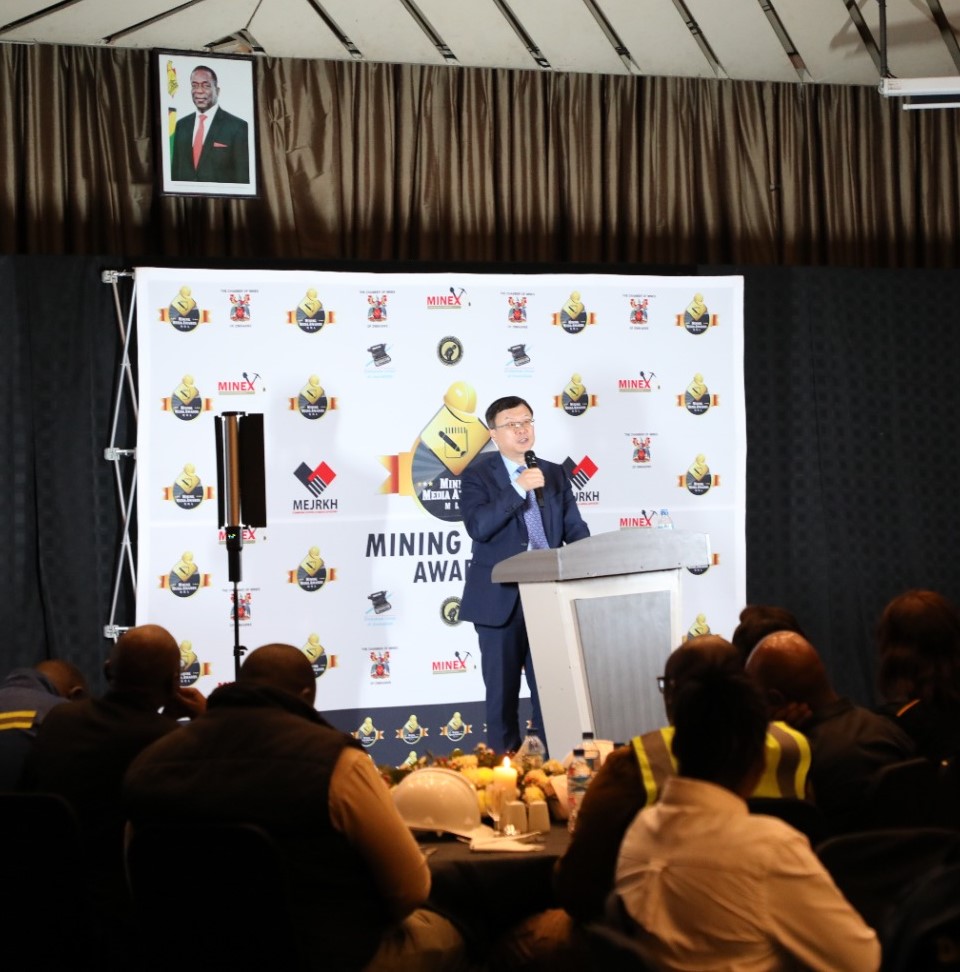
The embassy also underscored the importance of responsible mining practices that safeguard communities and environment.
In his remarks at the just-ended Mining Media Awards Chinese Ambassador to Zimbabwe, Zhou Ding said mining companies operating in the country should commit themselves to corporate social responsibility (CSR) and environmental, social, and governance (ESG) standards. He said mining development should balance economic gains with long-term sustainability.
“To ensure the success of Zimbabwe’s mining sector, we must collectively foster a healthy business environment- one that supports Zimbabwe’s long-term development.
“Responsible approaches to mining are needed to protect land. ESG is a good yardstick to achieve this because it ensures environmental protection, good governance and climate resilience,” he said.
He said the Chinese investment in the country’s mining sector is about driving economic growth.
“In examining Chinese investment in Zimbabwe’s mining sector, I would focus on four key areas:
“First, the Chinese investment in Zimbabwe’s mining sector is about driving economic growth. Chinese investment translates into jobs, tax revenue, and human resource development. The numbers speak volumes: according to ZIDA, over 1,000 new Chinese companies have registered here in the past three years, a significant portion is in mining. Overall, China-Zimbabwe trade and investment supports the livelihoods of over a million Zimbabweans, with more than half of this impact stemming from mining. Investors like Dinson Steel, Huayou, and Sinomine each employ thousands locally. They are actively training employees, transferring technology, and introducing advanced extraction and processing solutions. Their partnerships with vocational colleges in both countries are building vital human capital for Zimbabwe’s sustainable mining future,” he said.
He said Chinese mining companies are moving beyond extraction to adding value within Zimbabwe.
“Dinson now produces 600,000 tons of steel yearly. Its products—pig iron, steel billets, and more—are not exported to China but meet domestic and local demand and generate foreign exchange through regional sales.
“Environmentally, these companies are leading in protection measures, implementing waste treatment and water recycling systems. I am thrilled to learn that an additional 1,000 megawatts of solar projects by Chinese investors are underway to help address power challenges and support Zimbabwe’s green energy transition,” he said.
“Dinson is planning to transform the rural area of Mvuma into a new town for 10,000 residents and its employees. Max Mind Investment renovated and widened a 37-kilometer road, greatly improving travel safety for local villagers. As far as I know, the Chamber of Chinese Enterprises in Zimbabwe (CCEZ) is drafting a CSR report documenting over $100 million invested in hundreds of projects—building roads and clinics, drilling boreholes, and refurbishing schools,” he added.
He said while we celebrate these achievements, we must also candidly acknowledge the challenges in the mining industry.
“Mining is inherently complex, and balancing extraction with environmental protection and community interests is a global challenge. The Chinese Embassy consistently urges all Chinese companies to strictly comply with local laws, minimize their environmental footprint, and work hand-in-hand with communities.
“No partnership is perfect. In discussing China-Zimbabwe mining cooperation, we should neither offer only praise nor focus solely on shortcomings. Certain narratives, based on unverified information consistently and desperately smear Chinese enterprises. As we look into their allegations against Chinese enterprises, we have found that over 80% of them are exaggerated or fabricated, designed to incite xenophobia at little cost. Such tactics harm Zimbabwe’s business climate, and discourage investors.
“To ensure the success of Zimbabwe’s mining sector, we must collectively foster a healthy business environment—one that supports Zimbabwe’s long-term development. As H.E President ED Mnangagwa put it in his speech—“We are entrenching a business operating environment that is consistently predictable and transparent, where enterprises and innovation are rewarded and industry thrives.” I applaud this solemn commitment and dedication,” he said.
China remains the country’s biggest investor in mining, energy and infrastructure development and the remarks by ambassador Zhou reinforce the bid by China to align its investments in the country with global sustainability trends, while ensuring that development projects leave lasting benefits for communities and environment.
